Professional Learning for Adoption, Alignment & Classroom Practice
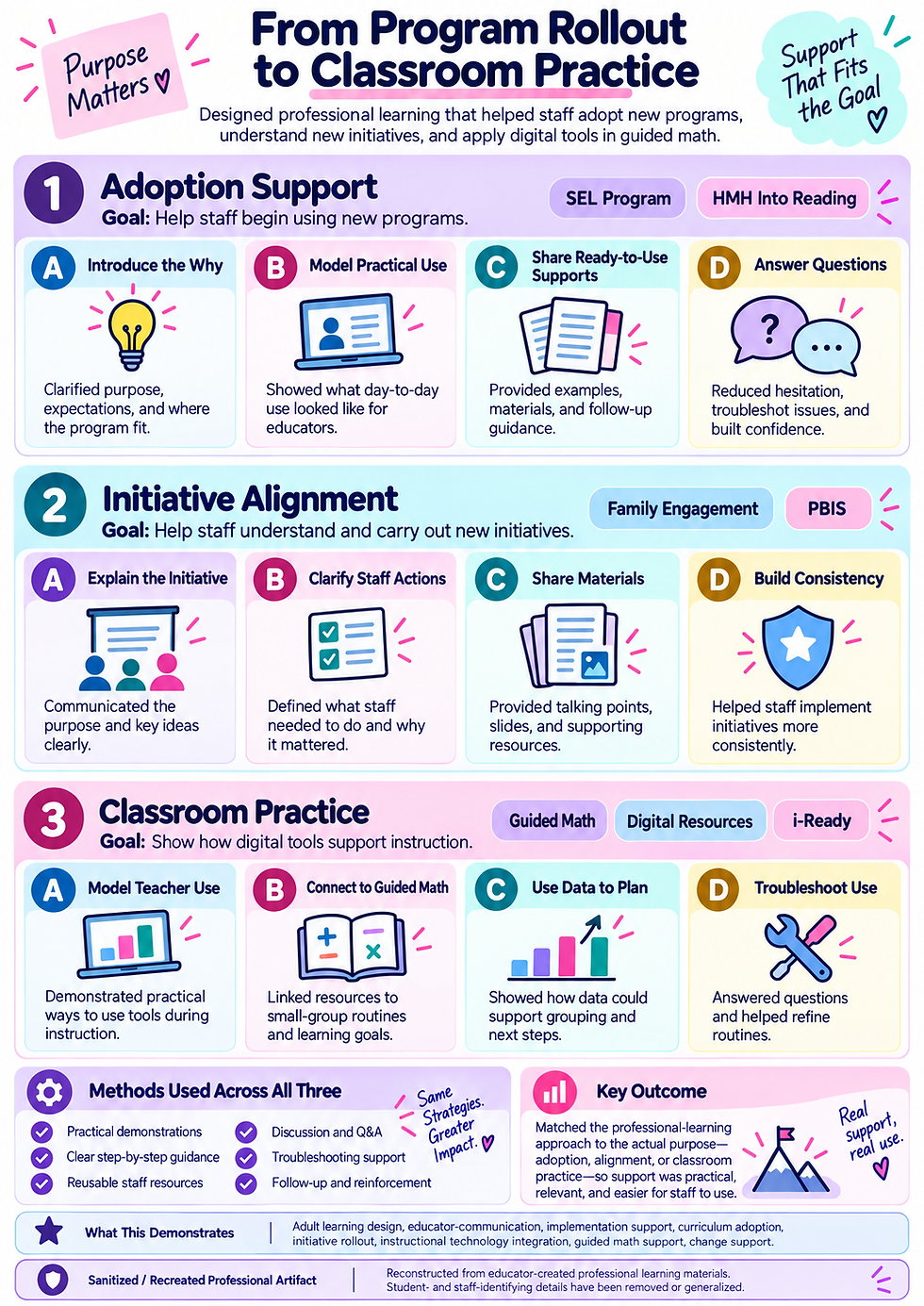
Co-created and co-presented professional learning for approximately 30–35 educators across three distinct needs: helping staff begin using a new SEL program and HMH Into Reading curriculum, introducing and aligning teams around new family-engagement and PBIS initiatives, and demonstrating practical digital-resource and i-Ready workflows for guided math.
Verified Professional Experience
Multiple public K–12 school and district professional-learning initiatives
Across multiple school years
Skills Demonstrated
Adult Learning, Facilitation, Training Design, Professional Learning, Adoption Support, Initiative Communication, Staff Alignment, Workflow Demonstration, Knowledge Transfer, Learning Content Development, Troubleshooting, Stakeholder Communication
Challenge
Professional learning across these initiatives served very different purposes. Some sessions needed to help educators begin using a new SEL program and HMH Into Reading curriculum; others needed to introduce and build shared understanding around new family-engagement and PBIS initiatives being put into place through committees; and technology-focused sessions needed to show how digital resources, including i-Ready, could be used within guided-math workflows. The challenge was designing and delivering learning that matched the actual purpose instead of treating every session as the same type of training.
Role & Scope
I co-created professional-learning presentations, handouts, and reusable resources and co-presented training for approximately 30–35 educators. Across the sessions, I used demonstrations, guided practice, discussion, troubleshooting, and follow-up. My role included translating new programs, initiatives, and instructional workflows into clear learning experiences that educators could understand and apply in their own work.
Approach & Execution
I adapted the learning approach to the goal of each initiative. For the SEL program and HMH Into Reading, the emphasis was helping educators begin using new programs and curriculum. For family engagement and PBIS, the focus was communicating new committee initiatives and building shared staff understanding and alignment. For technology and i-Ready, I demonstrated how I used digital resources within guided-math workflows so educators could see the tools in a practical classroom context. Across these different needs, I supported learning through demonstrations, practice, discussion, troubleshooting, reusable materials, and follow-up.
Key Decisions & Rationale
I did not treat professional learning as a one-size-fits-all presentation. Adoption support required practical exposure to new programs and curriculum; initiative communication required clarity and shared understanding; and technology training was most useful when educators could see tools embedded in an authentic instructional workflow. I therefore adjusted the emphasis, examples, and support around what educators actually needed to understand or do after each session.
Outcome & Impact
The professional-learning work supported three distinct outcomes: helping educators begin using a new SEL program and HMH Into Reading curriculum, introducing and aligning staff around new family-engagement and PBIS initiatives, and making digital-resource and i-Ready guided-math workflows visible through practical demonstration. Educators also received reusable materials, opportunities for guided practice and discussion, troubleshooting support, and follow-up rather than a presentation alone.
What This Demonstrates
This work demonstrates my ability to design and facilitate adult learning around different organizational needs rather than relying on a single training format. It reflects strengths in professional-learning design, facilitation, adoption support, initiative communication, staff alignment, workflow demonstration, knowledge transfer, learning-content development, troubleshooting, stakeholder communication, and adapting support to the purpose of the change.